
About us
We’re Ken and Sue,
travelers, storytellers, and lifelong food lovers.
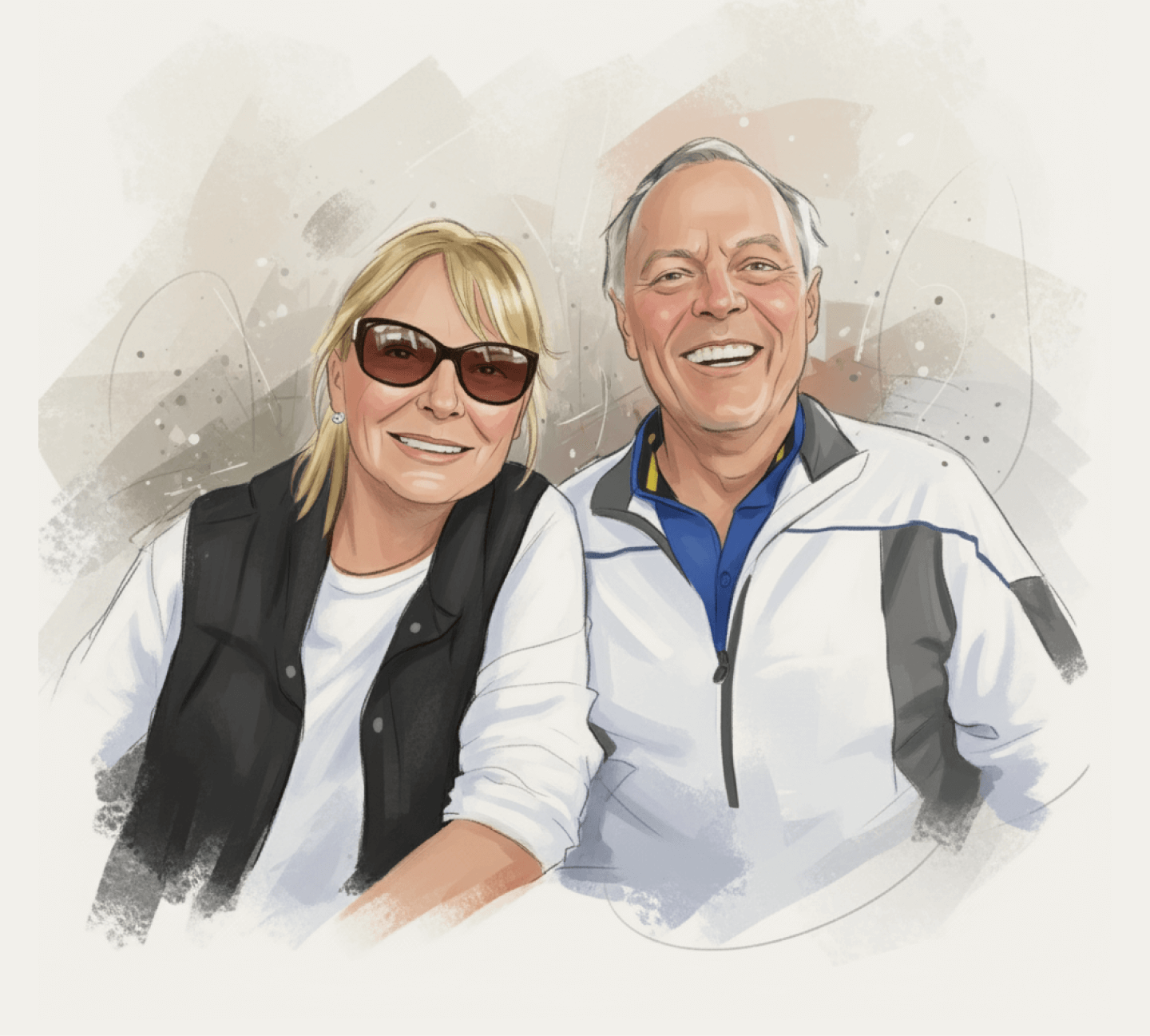
Let’s face it. If you’re like us there are only two states of being.
When you are sitting at home, you’re thinking about the next destination. Planning it. Researching what’s cool about it, what to see. Where to discover amazing local food. Dreaming about the next experience.
And there’s the trip itself. When you settle into the airplane seat and the ding that says the door is closing and the anxiety drops to zero, You’re about to embark on something special, something new and, of course, exciting like nothing you experience at home.
What’s the story?
-
Growing up, food at home was terrible. My mother was a lazy cook, threw together the quickest possible meals, and had no interest in how they tasted. As a kid, growing up in a Boston suburb, I ate a lot of junk, sodas, chips, chocolate bars, and pretty bad pizza.
It wasn’t until I moved to New York City that I discovered that food could be special. I discovered lots of different cuisines that never touched suburbia and flavors I’d never tasted before.
It didn’t have to be a fancy restaurant (although from time to time, we would splurge on one of those classic formal French restaurants that used to exist in the city). It could be a local Italian joint, a bar that served the best hamburgers ever, Chinese takeout, soul food in Harlem, or Pakistani meals at a tiny hole-in-the-wall in the (at the time) dangerous East Village. It was all so incredibly different from the food experiences I had back in my hometown.
It wasn’t one amazing meal that got me started. It was a juicy steak at the Palm, or Uncle Tai’s Beef at a white-table-cloth Chinese restaurant.
-
I got lucky in my senior year of high school by getting an internship at a local daily newspaper the summer before college. This was where I learned to bring the human element into a story.
I went out and gathered the facts, came back to the newsroom, and under the pressure of a deadline and the constant racket of phones ringing, typewriters clacking, and people yelling urgent updates, I learned to focus only on the story.
That job led to gigs over the years as a news reporter for an “underground” radio station, a factotum at a book publisher, a documentary filmmaker, and a television producer. The most important thing I learned from all those experiences was how to tell a story, how to bring it to life visually and emotionally. I had to step back and observe, ask questions, listen, and empathize. That’s the essence of storytelling.
When I travel, I “see” stories all the time. They are spontaneous scenes we accidentally stumble upon, brief interactions, or unplanned moments. And nothing beats the thrill of seeing something special, unusual, or spectacular for the first time. When I leave my familiar surroundings, I am far more attuned to the unfamiliar, and I find pleasure experiencing it.
-
We were having lunch with a friend in Australia who was an agent for social media influencers. She looked through some of our photos and said, 'You guys have been everywhere and you're just sitting on all this content. Why aren't you sharing it?'
Honestly, it hadn't occurred to us. But she was right—we had years of stories and meals just sitting on a hard drive. I wasn’t trying to build a following, but I did want the content to exist somewhere other than my computer. That conversation planted the seed for We Travel to Eat.
-
We laugh after reading the New York Times in the morning because we each take away something completely different, as if we are getting different editions.
When it comes to food, it’s very collaborative. We study the menu (often available on the restaurant website beforehand) and discuss what we like. We share most orders so that we can taste a broader range of items. We have to agree that we will both like what we get. She has some very particular tastes, so I don’t often get to try creamy or buttery food, mushrooms, or omakase (too much uncertainty in what you get). And my allergies to certain raw crustaceans limited our seafood choices.
We overplan a trip. I do the initial research and come up with too many things to do while we are visiting (I like options). I have specific sources for restaurants (New York Times, Eater, Condé Nast Traveler, and more), but you can’t always rely on them, so I’ll ask friends who have been to our destination for any favorites. If we take a tour with a local guide, I’ll pump them for their favorite restaurants because I know they’ll be authentic. We’re not looking to check off all the Michelin star restaurants; we want local, undiscovered favorites. We take a list of restaurants with us to try and “review” them afterwards to see if they stay on the list.
-
We often walk away from a meal or experience with our own private impressions. And then when we share them, the lasting impressions are often the same.
-
We are really self-reliant. We don’t need tours or cruises to experience a place. We’ll figure out the transportation, language barriers, and unfamiliar customs on our own. Thankfully, Google Maps and search have made this a lot easier. It means that our wandering exposes us to something unique, an interaction with a local, an enormous wall mural, a funky neighborhood, things that are not on the standard tourist routes.
-
Some experiences are big and some are very small but lasting. Standing in the window on the third floor of Starbucks in Shibuya, Tokyo, watching 3,000 people cross the streets at a single green light cycle at the “Scramble Crossing” is breathtaking. Yet recently I walked into a small garden on the grounds of a huge temple in the small town of Sedota on Ikuchijima Island in Japan's Seto Inland Sea. The moment I stepped into the garden, I was swept with a deep sense of tranquility and peace. I wanted to stay there forever.
-
We collect food photos, menu descriptions, and, often, recipes (You’ll be surprised at how many chefs will happily give you the recipe for something you really liked.). When I get home, I like to try to recreate them. It’s often a failure the first few times because, after all, the chefs worked hard to perfect the dish and probably cooked it dozens of times until they got it right. But it’s fun to try, and I have a tough food critic who breaks down my misses.
-
Smart restaurants are tuned into presentation. That makes a big difference to your dining experience. I’m not talking about fancy, foamy stuff, but just making a meal look good on a plate. A little garnish, a touch of a bright color like a slice of red bell pepper, and a sprig of cilantro can make a difference. You taste food not just with your mouth but also with your nose and eyes. So I plate food thoughtfully, not because I’m trying to please a customer but because it pleases me.
-
When we travel to another country, a big treat is the local food. It’s different than what you get in the US. After we go to Italy, we never seem to eat Italian food when we get home for a while, probably because it’s just not as good. It’s hard to find authentic Thai food outside of Thailand, and I think Chinese food has traditionally been modified to satisfy American taste buds. You may not like the food when you travel to another country, but it is usually made the way it’s supposed to taste, not what you are used to. But I don’t want to be a snob about it. If you like American Chinese food, then enjoy it. There’s nothing wrong with it.
-
There’s a restaurant in Napa, California, that has been making the top 50 or 100 lists since it opened a few years ago. (No, it wasn’t the French Laundry.) Of course, we had to try it. It was awful.
Like most pretentious restaurants, it had a set menu. (Okay, there are good restaurants with set menus, but sometimes the chef goes overboard. Like this one.
I could go on for pages about how disappointing it was, but I’ll stick to the highlights.
Starting with the amuse-bouche. The waiter dropped what looked like a planter box in the middle of the table, sprouting tiny bushes and trees. Hidden among the foliage were the “bouches.” (I guess it was symbolically the bouches among the bushes.) You were expected to forage for the food. What fun! And so stupid!
Around mid-meal, there was an optional add-on: some kind of exceptional steak from some special Sonoma cattle ranch. Given my level of hunger from the foraging, I opted for the steak. I didn’t know it would add another $120 to the already outrageous bill. And the steak was the size of a postage stamp. It must have been a very small cow.
And finally, the sommelier. What the Aussies would call a “total wanker.” The wine list (or tome) weighed at least 15 pounds. I could even pick it up. We hailed the sommelier to cut to the chase, so we didn’t spend the whole night flipping pages looking for something to drink.
We told him we didn’t like California wine but would like to start with a crisp, dry French Chardonnay, figuring that would narrow it down a lot. Instead, as if he was deaf, he spent an interminable amount of time telling us about how the restaurant found this little winery at the end of a dirt road in Sonoma (yes, not Bordeaux, but Sonoma, California) that we should try. He told a lot of goofy stories and finally wandered off when we lay our heads on the table and pretended to be asleep. Ten minutes later, I listened to him relate the same stupid stories to the next table.
There’s always a positive side to negative experiences, and mine was the opportunity to write a scathing, detailed review of our experience. Unfortunately, it was so caustic I never posted it because I was pretty sure I’d be sued (or worse). But it was fun to share with my friends.